
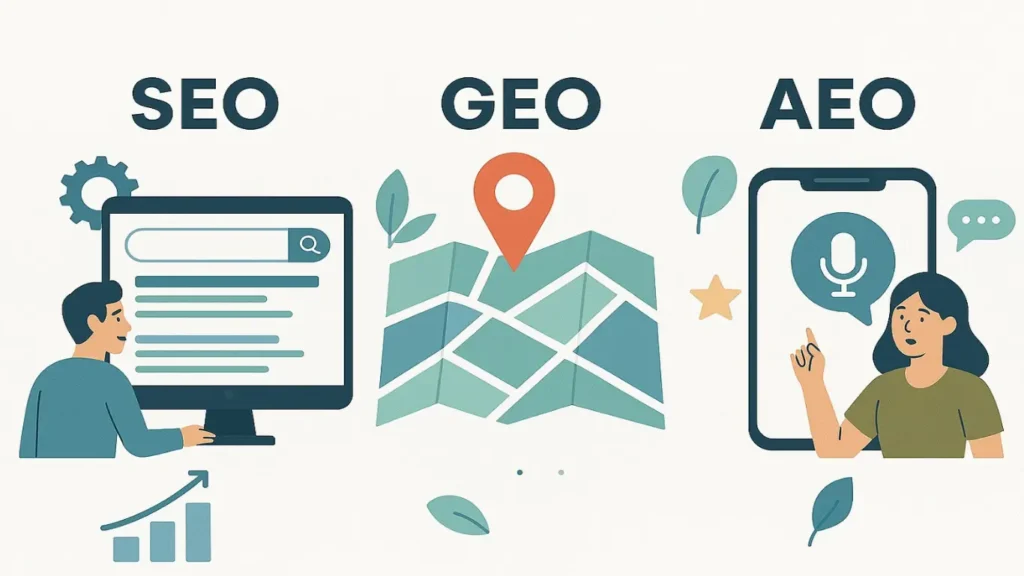
Search behavior is changing rapidly. Users no longer rely only on short keyword searches. Instead, they ask complete questions, use voice assistants, and depend on AI-powered tools like ChatGPT and Google AI Overview to get instant, accurate responses. Because of this shift, relying only on traditional SEO techniques is no longer sufficient.
To stay competitive in this evolving environment, websites must adapt to Answer Engine Optimization (AEO) and Generative Engine Optimization (GEO). These approaches help brands remain visible, credible, and discoverable in AI-driven search experiences.
If your goal is to future-proof your website and strengthen AI search optimization, understanding AEO and GEO is essential.
Understanding Answer Engine Optimization (AEO)
Answer Engine Optimization (AEO) focuses on structuring content so it delivers direct, clear answers to user questions. Rather than appearing only as a standard search result link, AEO allows content to surface as featured snippets, voice search responses, People Also Ask results, and AI-generated summaries.
AEO focuses on understanding what users are truly looking for. When people ask questions like “What is AEO in SEO?” or “How does AEO work?”,search engines tend to prefer content that presents information in a simple, precise, and clearly organized manner. Pages that do this effectively are more likely to be chosen as the main answer shown to users.
Why AEO Is Valuable
AEO increases visibility even when users do not click through to a website. Appearing as the direct answer helps build credibility and brand trust.
Voice search relies heavily on AEO. Voice assistants prefer brief, conversational responses that answer questions clearly.
AEO improves content quality by encouraging user-focused writing rather than keyword-heavy text.
AEO Optimization Tips
Structure your headings in a question format, for example “What is AEO?” or “Why is AEO important for websites?”
Provide concise answers immediately after each question.
Include FAQ sections on key pages.
Implement structured data such as FAQ and HowTo schema where applicable.
Target conversational search phrases, including:
- Answer Engine Optimization
- What is AEO in SEO
- AEO strategy for websites
What Is Generative Engine Optimization (GEO)
Generative Engine Optimization (GEO) focuses on optimizing content so AI systems can clearly understand, evaluate, and reuse it when generating responses. While AEO concentrates on direct answers, GEO ensures that AI tools can interpret your content across multiple contexts.
AI platforms do not rank pages the same way traditional search engines do. Instead, they assess content based on clarity, topical authority, consistency, and relevance. GEO helps align your website with these evaluation methods.
Why GEO Is Important for AI Search
AI-based search tools are becoming a primary source of information. Users now expect detailed explanations instead of lists of links.
GEO helps your content appear within AI-generated summaries and long-form answers.
It strengthens long-term authority by positioning your website as a trusted information source for AI systems.
How GEO Functions
GEO emphasizes in-depth topic coverage rather than isolated keywords.
It focuses on semantic structure so AI can understand how ideas and topics connect.
It rewards content that is logically structured and easy for machines to process.
GEO Optimization Best Practices
Build topic clusters instead of publishing unrelated individual articles.
Maintain a clear hierarchy with headings and subheadings.
Use an informative, neutral, and authoritative writing style.
Explain concepts thoroughly, even for beginners.
Incorporate related keywords naturally, such as:
- Generative Engine Optimization
- AI search optimization
- GEO for SEO
- AI-friendly content strategy
SEO vs AEO vs GEO Explained
Traditional SEO aims to improve rankings using keywords, backlinks, and technical improvements.
AEO focuses on delivering precise answers to specific questions.
GEO ensures content can be interpreted and referenced by AI systems.
These strategies work best together. SEO creates the foundation, AEO improves answer visibility, and GEO prepares content for AI-driven discovery.
Overlooking AEO and GEO means failing to align with the way people search for and interact with information today.
Best Practices for Combining AEO and GEO
Maintain strong SEO fundamentals such as fast loading speed, mobile optimization, and clean site architecture.
Include question-focused content on important pages.
Use summaries, bullet points, and definitions for clarity.
Establish authority through consistent publishing on related topics.
Avoid excessive optimization. Always prioritize readability and value for users.
Conclusion
The future of search goes beyond ranking on Google. Success now depends on whether AI systems can understand, trust, and reference your content. Answer Engine Optimization (AEO) and Generative Engine Optimization (GEO) help websites adjust to this evolving digital landscape.
By integrating SEO, AEO, and GEO, businesses can create content that answers real questions, supports AI comprehension, and builds long-term digital credibility.
To remain visible in 2026 and beyond, optimization must extend beyond search engines to include answer engines and generative AI platforms.
Hi, this is a comment.
To get started with moderating, editing, and deleting comments, please visit the Comments screen in the dashboard.
Commenter avatars come from Gravatar.